
Natalie Marie Gulsrud
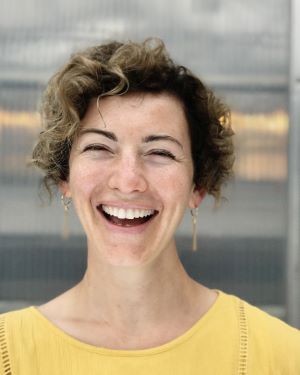
Associate Professor - Promotion Programme
Section of Landscape Architecture & Planning, Department of Geosciences and Natural Resource Management, University of Copenhagen
Research area: Just transition, sustainable pathways to climate resilience
Contact: Nagu@ign.ku.dk
What do you research?
My research explores how we can build fair and sustainable pathways to climate resilience. I focus on how decisions are made around urban green infrastructure (UGI) and how science is communicated, from the local to the global level. I work with a diverse team of researchers, designers, data experts, policy makers, private sector partners, and community activists to develop green city solutions that are multifunctional, inclusive, and just. Together, we study how social, ecological, and technological processes shape everyday urban life. By combining empirical research, theory, and data visualization, we aim to improve both urban research and practice. This work spans several areas, including urban resilience, nature-based solutions, land use planning and management, social equity and environmental justice, urban biodiversity, ecosystem services, and urban data science.
Why is it so important?
As cities move toward climate neutrality, conflicts over how to achieve green transitions are becoming more visible. Protests in Copenhagen against new green infrastructure highlight a growing “green discontent”: for some, climate action is moving too slowly; for others, it feels too disruptive, too fast, or unfairly distributed. These tensions raise deeper questions about who pays for the transition, who carries the burdens, and ultimately, who belongs in the green city. Urban sustainability and green infrastructure are not neutral projects—they are shaped by struggles over inclusion, justice, and the politics of belonging.
A project you are proud of?
I am proud of the work we have carried out in the Urban Solutions to the Green Transition Living Lab in Nordhavn, where we developed an innovative method to explore what constitutes “meaningful nature” in a rapidly transforming neighborhood. Between 2022 and 2024, we collected thick, geo-coded data from residents and users, including mapped points and annotated photographs of both positive and negative nature experiences. This material has been integrated into a dashboard accessible to decision makers, planners, and residents, providing a tangible tool to support more responsive and inclusive urban planning. Building on this work, we have also experimented with generative AI as a means of engaging youth in co-visioning future green cities. The results are playful, imaginative, and informative.
Updated December 2025
Through her participation in Policy Fellowship 2025-2026, Natalie will be working with Henrik Seiding, Administrative Director for the Department of Technology and Environment in Aarhus Municipality.
In previous policy fellowships, Natalie has worked with Paolo Perotti, Chief Legal Officer in the Ministry of Environment (Alumner - Policy Fellowship).